The face of everyday terror in post-war Barceloneta
For today’s generations, the name ‘El Gravat’ will mean nothing, but for those who lived through the 1940s and 1950s, this nickname evokes a bitter reality: that of a period of repression in which hunger, poverty and fear went hand in hand under the watchful eye of an arbitrary police force. Who was ‘El Gravat’?
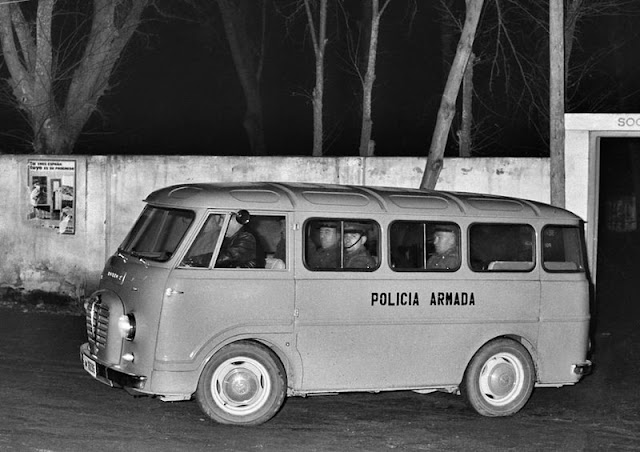
His name was Antonio Valentín and he was an unscrupulous oppressor, feared by children, women and men alike, from Barceloneta to Can Tunis via the Barrio Chino, the Marina neighbourhoods and Pueblo Seco, during the post-war period, and who became etched into the collective oral memory as a symbol of the fierce repression wielded by the victors of the war against the most disadvantaged classes, practising a policy of terror to impose suffocating repression.
Everyone knew him by the nickname ‘El Gravat’, due to the deep scars that smallpox had left on his face during childhood; he was likely just one of the many arrogant Falangists who had won the war and were rewarded with a position within the police force, in this case within the Municipal Police as a law enforcement officer, assigned to Heritage Surveillance, with a pistol on his belt and a truncheon in his hand. According to the writer and anthropologist Xavier Theros, he had seen him on the terrace of his home in Sants, completely naked and brandishing his service pistol in the company of prostitutes.
The scenes of repression
The actions of ‘El Gravat’ and his gang were characterised by their constant presence, as they roamed with impunity through the streets of the neighbourhoods, the port and the beaches, creating a climate of fear and extortion; by the end, they exercised fierce social control and institutionalised cruelty over the most disadvantaged sections of society.
His mere presence or the mere mention of his name was enough to clear the streets of children, women and men. In Barceloneta, he focused his efforts with impunity, mainly on the black market and street vending, which for many families, was the only way to survive in a Barcelona where food was rationed and medicines were non-existent.
He would station himself at the crossings connecting the port to the neighbourhood and would stop all the women carrying baskets of fish or white bread, or those hiding tobacco under their skirts, throwing the goods onto the ground or reporting them if they did not give him a share of the goods. Some witnesses we have spoken to place him at the Moll de Poniente, where he would wait for boats arriving early or with undeclared catches, keeping a share of the goods in exchange for not issuing a fine.
According to the oral history of the old street vendors at the Barceloneta market, the name ‘El Gravat’ was associated with a policeman who ‘always wanted a free meal’. He would sometimes burst through the narrow streets at great speed in his grey Ford to disperse the vendors and confiscate their goods. He did not hesitate to use shoves and beatings to confiscate the goods, and he could be so petty that he would even force the poor people collecting ‘sea coal’ (pieces of coal that fell from ships, which they later sold on the street to earn a little money – purely for survival) on Somorrostro beach to hand over part of what they had gathered. Another of her misdeeds involved the shanty dwellers of Somorrostro: she would confiscate the timber from old boats that the shanty dwellers used to build their homes and burn it right there on the spot to prevent it from being reused, leaving families homeless.
However, the opposite was true in the Montjuic area with its shanty towns; here he came up against the Romani community, who organised themselves and managed to ensure he did not exert as much pressure. We also find him in the area around the Estación de Francia, where he would wait for the arrival of the train from Seville to screen the new arrivals: those immigrants who, in the 1950s, came from villages fleeing poverty, would encounter this man—whom they called ‘El Picao’—spreading his notoriety as far as the south of the Peninsula. As soon as they got off the train, they were intercepted by him and his gang, and if they could not prove they had a fixed address or an employment contract, they were arrested. Many were sent to the Montjuïc Missionary Wing to be subsequently deported to their home towns on the so-called ‘sweep trains’.
The fear people had of him and his notoriety throughout Spain meant that many would jump from the moving train before reaching the station. Somewhere between myth and moral degradation, the person who best captures this individual is Paco Candel, in his books, where he describes life in the shanty-town neighbourhoods. He describes him as the absolute sheriff and hunter of the poor. One of the best-known anecdotes about him involved a group of fishmongers from Can Tunis who, fed up with his abuses, cornered him and gave him a historic beating, using large frozen fish as makeshift truncheons. This anecdote illustrates the only language this character understood: brute force. Just as he did against the Romani community in Somorrostro, the Can Tunis area or Montjuïc.
El Gravat was the absolute sheriff
Candel explains specific details of his modus operandi: he had the ability to detect ‘the sound of a builder’. Immigrants would try to erect their shacks at night because the law stated that, if there was a roof and a fire lit, they could not be demolished immediately. El Gravat would appear out of the darkness like a ghost to knock them down before they were finished. His cruelty went so far as to let the family finish building the shack with all their hard work, and just as they were about to put the roof on, he would appear with his sledgehammer and force them to tear it down themselves. He vanished from the streets the moment his actions began, in the 1970s, to cause problems for the City Council, leaving behind him the legacy of an era in which the dignity of the most vulnerable depended on the whims of a man with a scarred face and a uniform that conferred too much power. ‘El Gravat’ did not protect the citizens; his mission was, quite simply, to keep them subjugated.