1977, When we stopped praying and started laughing
In Barceloneta, over the course of nearly three centuries, there have been many shortages, but there has never been a lack of schools. Mine was the Virgen del Mar public school. It was housed in a large, gray stone building that looked like a castle, with that solemn—even oppressive—air that characterized education during the Franco regime, whose pedagogical motto was: “Learning comes with blood.” There was a portrait in the classroom of a bald man whom my grandfather would whisper was “the Caudillo,” though I didn’t know what that profession entailed. When we were in third grade, he died, and—presumably to celebrate the occasion—we were given two weeks off. But our school life didn’t change immediately with Franco’s death. In fourth grade, we still had the same teachers with their thin mustaches. A class consisted of spending the afternoon copying an entire chapter from the textbook word for word into our notebooks while the teacher read the newspaper. At Christmas, my mother would still bring the principal, Mr. Chamorro—who was a very polite man—a bottle of cognac bought at Bodega Fermín. We still attended school with girls and boys separated. When we arrived in the morning, we would still say our prayers before class began.
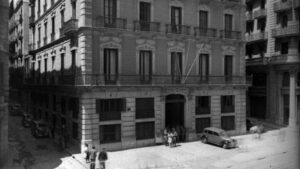
In fifth grade, the school was undergoing renovations, so they sent us to another location: the building of a former school on Rector Bruguera Street that everyone called “Las Damas.” At the time, I thought it must have something to do with the board game checkers. It wasn’t until many years later that I learned of the existence of the Very Illustrious Ladies’ Association of Barcelona, a charitable organization founded in the mid-19th century by women of high society dedicated to promoting the education of women and children facing financial hardship. A search in the 1947 Barcelona Municipal Gazette allows us to trace their work in our neighborhood: “To grant the School of Our Lady of the Conception, run by the Very Illustrious Ladies’ Association and located at 4 Rector Bruguera Street, Barceloneta, the status of a ‘protected school,’ and that, as financial assistance to the school, the City Council assume responsibility for paying the school’s electricity bill, which amounts to 600 pesetas annually.”
We were never going to see any high-society ladies that school year. There wasn’t anything particularly aristocratic about the place. We didn’t care that it was crammed between other buildings, that the classrooms were small, or that the old electric heater barely gave off any heat. But we did have one concern: There’s no playground here! And right away, a second concern popped up: Watch out! Girls in our class!
The girls were a mystery. Instead of playing soccer or fighting, they played games like looping rubber bands between their legs or hopscotch, jumping inside chalk squares as if they were dancing. They were from the neighborhood, but they were from another world.
The mystery of where we were going to have recess was solved right away: the playground was on the building’s rooftop. It was much smaller than our court at Virgen del Mar (La Repla), and they’d put up a net enclosure to keep the balls from rolling into the street. It felt like being in a parakeet cage.
But there was something even stranger that year when we stopped praying at the start of class: Our new teacher’s name was Pedro. And that was very strange. Extremely strange! The teachers before him were named Mr. García, Mr. Palop… but this new teacher was simply called Pedro. He was young and told us to call him by his first name.
One day we had a field trip planned, and we arrived in class with our aluminum water bottles and sandwiches, but it started to rain and we had to cancel the trip. Instead of having a regular class, Pedro said it would be a day of activities. We did arts and crafts, ate our sandwiches in the classroom as if we were at summer camp, and in the afternoon some of the girls decided to sing. Loli stood in the middle of the circle of chairs and sang a very romantic song by Umberto Tozzi with great passion. I loved that there were girls in the class!
One day, Pedro said he was going to read aloud an excerpt from the literature textbook (it was *Senda* by Santillana). None other than *Don Quixote*! We groaned at the prospect of the bore we were in for. But he started reading, using different voices for each character in a really funny way, as if we were listening to it on the radio. At one point, he read about a woman who was pretending to be a princess of “the gay kingdom(“Reino Maricón”),” and we were all stunned. Immediately, he burst out laughing. “No! It’s the kingdom of Micomicón!” And that’s when we discovered that teachers could laugh, too. And we all laughed. So many years later, I am deeply grateful to that very human teacher, Pedro del Olmo, who taught me that learning comes more easily when there’s laughter.