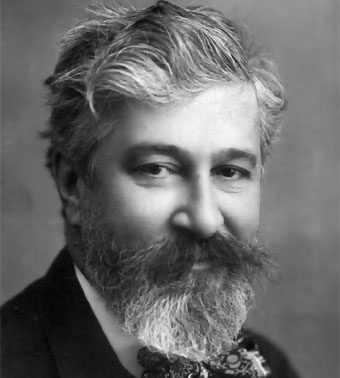
Santiago Rusiñol (Barcelona, 1861 – Aranjuez, 1931) is one of the most representative figures of the Catalan Modernist movement. A painter, writer, journalist, collector, and playwright, he embodied the model of the bohemian artist of the late 19th century: the heir to a bourgeois industrial family who renounced continuing the family textile business to devote himself fully to art. This decision made him not only a multifaceted creator but also a cultural innovator who would profoundly shape Catalan artistic life and one of the bearers of the new avant-garde ideas coming from Paris, which made him a fundamental reference point for his education and modern conception of art and theater.
Born on Princesa Street in Barcelona on February 25, 1861, he was orphaned by his father at a very young age, and it was his grandfather, Jaume Rusiñol, the head of the family, who took responsibility for his grandchildren’s upbringing, with strict discipline and the hope that Santiago would ensure the continuity of the family factory. But he did not succeed due to Rusiñol’s strong artistic calling.
One little-known aspect is Rusiñol’s connection to Barceloneta, a neighborhood that frequently appears in his work; this close connection can be explained in two ways: through family ties and through literature.
Family ties
On the one hand, his marriage to Lluïsa Denís linked him to a prominent family in the seaside neighborhood, known as major landowners and rentiers. Lluïsa’s paternal grandfather was François Denís, originally from Paris, who came to Catalonia as a Napoleonic soldier. In 1815, after the War of Independence ended, François settled permanently in Barcelona, working as a merchant. On August 22, he married Lluïsa Gené, a native of Barcelona, in the church of Santa María del Mar. She was the widow of the gardener Ramon Via and the daughter of landowners—also gardeners, now deceased—who owned multiple properties in the Barceloneta area. Lluïsa also owned a house-factory, complete with a waterwheel, in the Taulat neighborhood, which, together with her properties in the seaside district, helped provide the sufficient income necessary for the couple’s future social rise.
Three children were born to this marriage: the first, Agustí (Lluïsa’s future father), Lluïsa, and Josep. The family gradually consolidated its position in the Barceloneta area.Throughout the 19th century, the Denis family became an influential dynasty, with business interests and an active presence in the life of the neighborhood. In 1822, they acquired 40 of the 48 houses on a block in Barceloneta, formerly owned by the Count of Linati, who had inherited it from the childless widow of the first owner, Field Marshal Carlos Prebost. In addition to running an axle factory, they also pursued opportunities in new fields such as the trade in colonial goods and even held political office.
Agustí Denís held various public offices representing La Barceloneta. In 1870, following the devastating yellow fever epidemic that struck the neighborhood, he served on a committee tasked with petitioning the government for a one-quarter reduction in property taxes due to the hardships the neighborhood had endured.
Agustí Denís married Dolors Reverter in 1858 in Sant Miquel del Port; she was the daughter of a worker at the Denís factory, originally from Vinaròs. Dolors, or Grandma Loles, as Rusiñol called her, came from a humble family—one of many—who, during the 19th century, came from northern Valencia to work in maritime-related jobs and who, later, due to the industrial activity that developed in the neighborhood, went on to work in the factories. She was a woman of extraordinary beauty, which might explain why this non-strategic and atypical marriage took place. Agustí Denís and Dolors Reverter were the parents of Lluïsa, who, due to the death of her only brother when he was a child, would become the heiress and inherit all the family’s real estate.
The wedding of Rusiñol and Lluïsa Denís, held on June 19, 1886, at the Church of Santa Anna, strengthened this bond between the Modernist artist and La Barceloneta.
Literary connection
Another link between Rusiñol and the neighborhood is reflected in his literary work: a three-act play titled *Miss Barceloneta*, which premiered on February 3, 1930, at the Teatre Català Novetats. This satirical comedy showcased Rusiñol’s more traditionalist side and his interest in the working-class neighborhoods of Barcelona.
Set in the seaside neighborhood, the play features a poor young woman who adopts foreign fashions to appear to have a higher social standing than she will ever have, without falling into the trap of prostitution. Through the contrast between the protagonist’s aspirations and the reality of her surroundings, Rusiñol constructs a subtle and ironic critique of a society that seeks to exploit innocent and poor young women.
The protagonist is Laieta, a vain young woman who wants to be beautiful and achieve work and status; she lives in a ground-floor apartment in Barceloneta with her mother Munda, who is an ironer, and her uncle Gumersind, a naive and gentle man who paints walls and loves the arts and culture—everything her nephew does. Laieta’s suitor is Ramonet, who works modestly on the railroad. Laieta enters a beauty pageant and wins, prompting a series of malicious characters to try to lead her astray and take advantage of her in exchange for money and praise for her beauty. In the third act, Laieta falls ill with smallpox and is taken in by her mother, who cares for her. She discovers that beauty and frivolity aren’t everything, and that what truly matters is family and friends. With this play, Rusiñol demonstrates his ability to portray the real Barcelona, beyond the bourgeois salons, using the neighborhood as a setting, with its working-class life and social contradictions, inspired by an author who knew how to capture the spirit of his time and transform it into art—and we’d like to think that Barceloneta was an important place for him.